Analytics & compliance
What happened, and what you will have to prove.
Two different questions with the same thing underneath. The dashboards answer how the operation is doing. The Compliance Center answers whether, with what you have already recorded, you could sit in front of an auditor today. Neither asks you to type anything new.
Dashboards
Three readings of the same operation
Compliance Center
The standard cross-checked with your records
Dashboards
Three boards, depending on who is looking.
Leadership cares about money and uptime. The maintenance manager cares about the backlog and who is overloaded. Whoever buys cares about the capital sitting in the warehouse. It is the same operation read through three pairs of eyes, so it is three boards and not one with forty things on it.
Leadership. Cost, availability, MTTR and MTBF, preventive compliance, days without a lost-time accident and the cost impact of incidents.
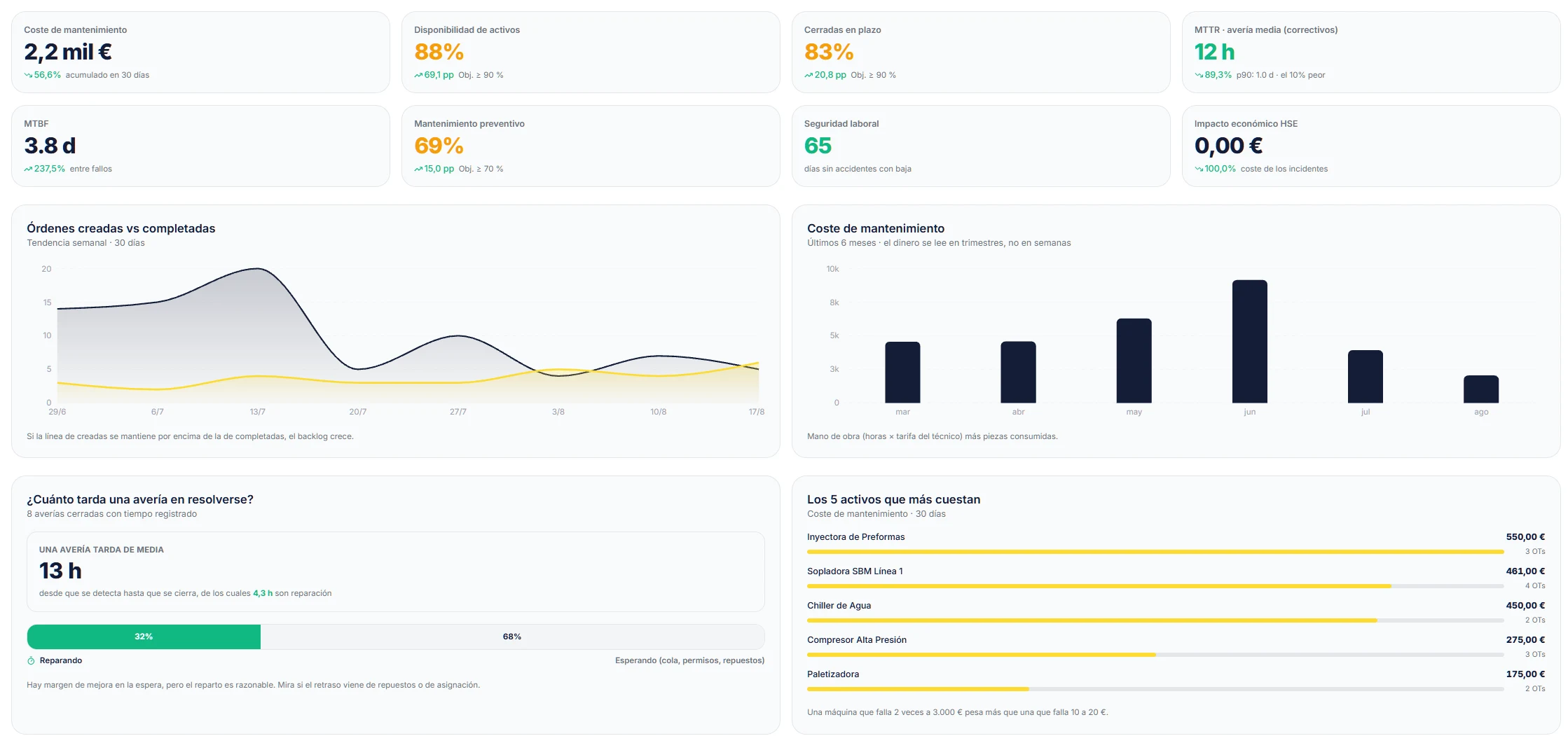
Some of the indicators on this board
Asset availability
88%
Target ≥ 90 %
Closed on time
83%
Target ≥ 90 %
Preventive maintenance
69%
Target ≥ 70 %
Workplace safety
65
days without a lost-time accident
You set the targets
Under every indicator sits its target. 88 % availability does not mean the same on a fleet as on a bottling line, so the threshold is adjustable and the colour follows it. Nobody decides for you what good looks like.
And what is shown, too
Which indicators appear, in what order and over what time window is configured per customer. A board full of things you do not care about is a board nobody opens in week two.
Every chart says how to read it
Under each one there is a line explaining what to look at. "If the created line stays above the completed line, the backlog is growing." You do not need an analyst beside you to read the board.
By site or the whole company
The same board can be filtered to one plant or one vessel, or seen across the whole fleet. It is the same selector the rest of FluX uses, so what you see here matches what you see on any other screen.
Compliance Center
The frightening question, answered on one screen.
"If the auditor comes tomorrow, are we ready?" Today that answer costs three days of folders and phone calls. Here it is a live cross-check: what each standard in your sector requires, against what you already have recorded in FluX. It is not an AI opinion or a questionnaire somebody fills in. It comes from looking at your records.
- A live cross-check, not a questionnaire
- Deterministic: AI does not decide it
- By site or the whole company
- It unfolds standard by standard

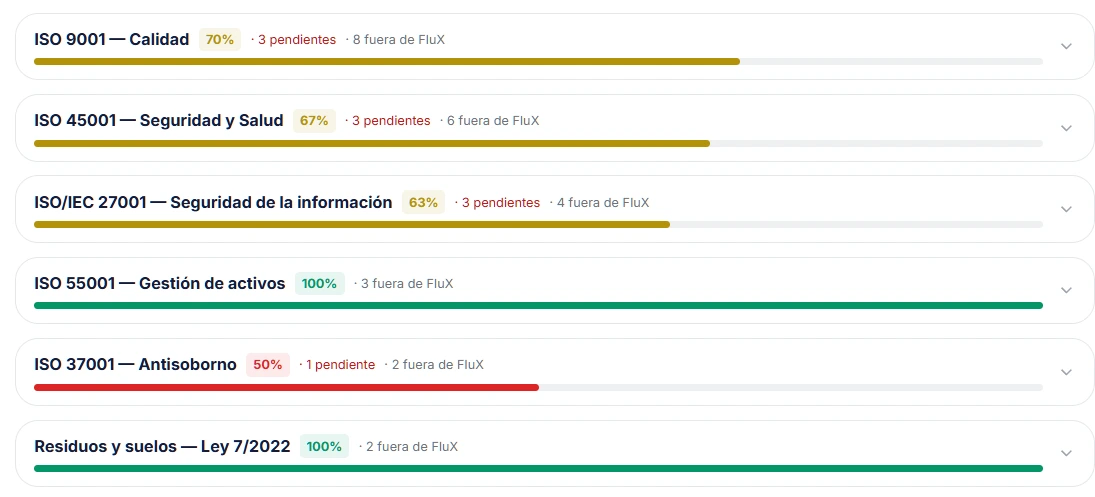
Audit-ready
Whole company
- ISO 9001 — Quality70%
3 pendientes · 8 outside FluX
- ISO 45001 — Health & Safety67%
3 pendientes · 6 outside FluX
- ISO/IEC 27001 — Information63%
3 pendientes · 4 outside FluX
- ISO 55001 — Asset management100%
3 outside FluX
- ISO 37001 — Anti-bribery50%
1 pendientes · 2 outside FluX
17 open points across 11 standards. Another 44 fall outside FluX and are excluded from the percentage.
What falls outside gets said.
There are clauses no maintenance record can prove: an insurance policy, minutes of a committee, a contract. FluX lists them, counts them separately and leaves them out of the percentage. A traffic light that turned green by ignoring what it does not control would be no use to you on audit day.
And part of that evidence you produce without noticing.
A form is evidence somebody creates for the auditor. A preventive work order exists because maintenance was due and somebody did it. A received purchase order exists because material arrived. The difference shows on inspection day: the second kind cannot be manufactured the night before.
That is why the Compliance Center no longer looks only at forms. It looks at the work your team does in FluX anyway and counts it as what it is: a record with its date, its author and its trail behind it.
- ReportsIncident, hazard, non-conformity and complaint
- Received purchasesSupplier control: what arrived, from whom and when
- Completed preventiveEquipment maintenance, with its closing date
- Production sheetsBatch traceability, with good output and scrap
- Meter readingsResource consumption, measured and not estimated
22 requirements that used to close only by filling in a sheet now close by working. And no form has been removed: the one you already used counts exactly the same.
And where to start, which is the other question.
Knowing how many points you are missing and which standards they sit in is not a work plan: it is a list. This screen turns it around. Instead of grouping by standard, it ranks the actions by how many points each one closes, and puts the one that covers most in a single go at the top.
It works because the overlaps are real: the ISO standards share the Annex SL skeleton, so competence, non-conformities and internal audit show up in nearly all of them. In the industry catalogue the extreme case is the internal audit form, which closes 29 requirements spread across 22 standards.
Your sector's standards, already in.
The catalogue carries 81 standards and 495 requirements, written one by one with their clause and with which FluX record proves them. From ISO 9001 and 45001 to MARPOL, ISO 55001 or Spain's Law 7/2022 on waste, plus the three GFSI food schemes: IFS Food, BRCGS and FSSC 22000. It is not a list of names: every point knows what evidence closes it.
81
standards in the catalogue
495
requirements with their clause
257
form templates
Figures from the FluX catalogue (src/lib/normas), not from any customer.
And yours as well.
Almost no company runs on public standards alone. There is the spec from your big customer, the internal protocol the group imposed, the requirement the last audit left behind. They are registered as your own standard, with their own points, and from then on the traffic light, the dossier and the form builder treat them exactly like an ISO.
- The customer's own standards
- With their own requirements
- They enter the traffic light too
- And the auditor's dossier
The forms you already had, classified.
The problem with moving to a new system is everything that came before: fifty sheets built by hand or migrated from a spreadsheet, and nobody knows which clause each one covers. The AI reads them, looks at the name and the fields, and proposes which requirement each one maps to, with a confidence level.
It proposes. It saves nothing. A person confirms on screen and only then is it written. In compliance, letting the AI decide the status on its own would be dangerous, so it cannot.
AI suggestions
IAMeasuring Equipment Calibration
ISO 9001 §7.1.5Confidence: HighIncident Report
ISO 45001 §10.2Confidence: HighProduction Shift Report
ISO 9001 §8.5.1Confidence: Medium
Every month, without anyone remembering.
On the 1st the previous month compiles itself: orders, HSE reports, preventive work, inventory, purchasing, tasks and whichever forms you marked. It lands tidy in Files, in its "Compliance" folder for that month, with an executive summary written on top. A year later you have nothing to reconstruct: you have twelve folders.
- Automatic on the 1st
- Filed by month
- With an executive summary
- Or by hand, whenever you want
Files · Compliance
- Compliance · 2026-08In progress
- Compliance · 2026-077 documents
- Compliance · 2026-067 documents
- Compliance · 2026-057 documents
Generated on the 1st with the previous month
And on audit day, a ZIP.
A PDF on your company template, which is what gets read and handed over, and an Excel annex, which is what gets filtered and sampled. Both grouped by clause and in the same order, so the auditor does not have to search. No standard requires it in this shape: audit practice asks for it, and almost nobody does it.
Grouped by clause
Evidence is ordered by the criterion being audited, not by date or by module. That is how an auditor looks, so that is how it is handed over.
With an integrity seal
A manifest with the SHA-256 of every file. Whoever receives it can check for themselves that nothing was touched after it was generated. It is the BagIt convention, cut down to what is useful here.
Empty clauses included
A clause with no records still appears, with a zero. Leaving it out would be hiding it, and hiding something in a dossier is exactly what you cannot do.
No score
The dossier carries no percentages and no "8 out of 10". That is the traffic light, which is for getting ready. What you hand over is the evidence, and the auditor gives the grade.
And no AI anywhere in it
The ZIP comes out of queries against your data, not out of a model summarising it. "An AI summarised it" is not traceability: whoever audits has the right to walk back from the dossier to the original record, and for that the path has to be arithmetic.
Shall we look at your sector on the call?
Tell us which standards you answer to and we will show you the traffic light with them inside, and the dossier that would come out. In thirty minutes you know whether this removes your three days of folders.